Art, design and visual culture encyclopedia.
Browse 100 focused reference pages spanning prehistoric image-making, architecture, artists, materials, typography, digital tools and current web-design technology. Each page is built to stay on topic, explain the subject clearly and connect it to nearby ideas.
- Jump directly into a topic and read a concentrated overview.
- Use the facts, section map and related pages to keep studying.
- Move between historical subjects, materials, software and web topics without losing context.
Prehistoric Art & First Images
Early marks, cave painting and the first visual evidence of symbolic image-making.
Altamira Cave Paintings
Altamira is celebrated for polychrome bison whose bodies take advantage of natural ceiling relief, and for its central role in the nineteenth-century recognition that Paleolithic people created complex cave art.
Blombos Cave Engravings
Blombos Cave preserves some of the clearest early evidence for deliberate geometric mark-making by Homo sapiens, including engraved ochre pieces and a drawn cross-hatched design made with red ochre.
Chauvet Cave Paintings
Chauvet-Pont d’Arc contains an exceptionally early and well-preserved body of cave imagery, including lions, rhinoceroses, bears, horses and other animals rendered with overlapping contours, shading and use of the limestone surface.
Lascaux Cave Paintings
Lascaux is one of the most studied Paleolithic decorated caves, famous for large animal compositions such as the Hall of the Bulls and for a technical repertoire that includes painting, drawing, spraying and engraving.
Venus Figurines
“Venus figurine” is a modern umbrella term for diverse Paleolithic female figures. The label does not prove that the objects represented a single goddess, fertility cult or shared meaning.
Ancient Civilizations & Early Visual Systems
Objects, monuments and structured visual languages from the ancient world.
Ancient Egyptian Wall Painting
Egyptian wall painting developed durable systems for scale, pose, registers, color and inscription, yet those systems changed across periods and were adapted to different tomb and temple functions.
Assyrian Palace Reliefs
Neo-Assyrian palace reliefs turned long architectural walls into controlled narratives of royal warfare, hunting, tribute, ritual and supernatural protection.
Fayum Mummy Portraits
The portraits commonly called “Fayum” mummy portraits combine Greco-Roman portrait painting with Egyptian funerary practice, preserving individualized faces on wood panels placed over wrapped mummies.
Shang Dynasty Bronze Design
Shang ritual bronzes combine technically controlled piece-mold casting with dense relief ornament, animal motifs and forms tied to elite ceremony, lineage and ancestral offerings.
The Standard of Ur
The so-called Standard of Ur is a reconstructed inlaid object from the Royal Cemetery at Ur. Its two principal panels organize war, prisoners, animals, tribute and feasting into horizontal registers.
Greek, Hellenistic & Roman Art
Classical form, ideal bodies, narrative sculpture and the visual systems of antiquity.
Classical Greek Contrapposto
Contrapposto describes a standing pose in which the body’s weight is concentrated on one leg, producing linked adjustments through the pelvis, torso and shoulders rather than a rigid bilateral stance.
Greek Architectural Orders
The Greek architectural orders are systems of proportion and detail connecting column, capital and entablature. Doric, Ionic and Corinthian are related traditions, not interchangeable decorative caps.
Greek Red-Figure Pottery
Red-figure pottery reversed the older black-figure method: the background was coated with refined slip while figures were left in the color of the clay, allowing painters to draw anatomy and drapery with a brush rather than incising most interior lines.
Laocoön and Hellenistic Expression
The Laocoön group is a landmark of ancient sculptural drama: three bodies twist against coiling serpents in a composition built around pain, resistance and tightly controlled anatomical tension.
Parthenon Architecture
The Parthenon is a Doric peripteral temple whose proportions, marble construction, optical refinements and integration of sculpture made it a defining monument of fifth-century BCE Athens.
Asian Art Traditions
Painting, calligraphy and court or religious traditions across major Asian contexts.
Angkor Wat Visual Design
Angkor Wat combines temple mountain, axial causeways, concentric galleries, five central towers and long narrative reliefs within the larger engineered landscape of the Khmer capital region.
Chinese Calligraphy as Visual Art
Chinese calligraphy is both writing and visual practice. Character structure remains legible, but brush speed, pressure, rhythm, spacing and script type create expressive differences that cannot be reduced to font choice.
Chinese Landscape Painting
Chinese landscape painting, often discussed through the term shanshui or “mountain-water,” developed as a major field for brushwork, spatial construction, poetry, philosophy and historical dialogue with earlier masters.
Hokusai and Woodblock Design
Hokusai transformed ukiyo-e landscape through bold cropping, strong contour, unusual viewpoints and technically sophisticated color woodblock printing, most famously in Thirty-six Views of Mount Fuji.
Mughal Miniature Painting
Mughal painting grew in imperial workshops that brought Persian manuscript traditions into sustained contact with South Asian artists, court history, natural observation and selected European pictorial devices.
Islamic, African, Indigenous & Oceanic Art
Pattern, material culture and regional traditions outside a narrow Eurocentric canon.
Arabic Calligraphy in Visual Design
Arabic calligraphy developed multiple formal scripts for manuscripts, architecture and objects. Letter proportion, pen angle, rhythm and spacing are technical systems, while the choice of text determines religious, political or poetic meaning.
Benin Court Bronzes
The works known collectively as the Benin Bronzes were made by specialist Edo court guilds for the Oba and royal institutions. Many famous plaques are actually cast brass, and the history of their removal in the British attack on Benin City in 1897 is central to their modern interpretation.
Ife Portrait Sculpture
Ife sculpture includes technically extraordinary copper-alloy and terracotta heads with controlled naturalism, fine surface lines and royal associations. Their discovery overturned racist assumptions that sophisticated metal casting could not have developed independently in West Africa.
Islamic Geometric Pattern
Islamic geometric ornament uses repeat, symmetry and interlocking construction to organize architectural and portable surfaces. Its history is regional and material, not the product of one universal ban on figurative imagery.
Navajo Weaving
Diné weaving developed from regional textile knowledge, sheep husbandry and continual technical innovation. Blanket, rug and regional trading styles reflect changing economies, materials and markets rather than one fixed “Navajo pattern.”
Byzantine, Medieval & Gothic Art
Manuscripts, mosaics, cathedrals and sacred image traditions.
Byzantine Mosaic
Byzantine mosaics use small tesserae, including reflective gold and colored glass, to create monumental sacred images whose surfaces change with architecture and light.
Chartres Cathedral
Chartres Cathedral is one of the best-preserved High Gothic ensembles, combining a largely early-thirteenth-century nave and choir with older west-front elements, extensive sculpture and an exceptional body of medieval stained glass.
Gothic Cathedral Architecture
Gothic cathedral architecture developed through structural, liturgical and urban changes rather than through one invention. Pointed arches, rib vaults and exterior buttressing allowed builders to reorganize wall, height and window area in distinctive ways.
Hagia Sophia
Hagia Sophia fused a vast central dome, pendentives, half-domes, colonnades and reflective interior surfaces into one of the most influential buildings of late antiquity and Byzantine architecture.
The Book of Kells
The Book of Kells is an Insular Gospel book celebrated for dense interlace, decorated initials, evangelist imagery and pages where letterform, ornament and sacred text become inseparable.
Renaissance Art & Humanism
Humanism, observation, perspective and the revival of classical models.
Albrecht Dürer and Print Design
Dürer used printmaking not as a secondary reproductive craft but as a central artistic medium, combining exact line control, ambitious iconography, personal branding and international distribution.
Jan van Eyck and Layered Oil Technique
Jan van Eyck did not invent oil painting, but his workshop exploited oil-bound paint with exceptional control of translucency, reflection, saturated color and microscopic detail.
Leonardo da Vinci and Sfumato
Leonardo’s sfumato is the controlled softening of edges and tonal transitions so forms emerge without hard outlines. It is one part of a broader practice grounded in drawing, optics, anatomy and repeated revision.
Linear Perspective
Linear perspective uses a consistent viewing position, horizon and vanishing point to organize apparent depth. Its Renaissance formulation was a historical construction, not a universal way that all cultures represent space.
Michelangelo and Disegno
For Michelangelo, drawing was not merely preparation for painting. Disegno linked draftsmanship with planning, invention and the intellectual control of form across sculpture, fresco and architecture.
Baroque, Rococo & Court Culture
Dramatic movement, courtly display and the persuasive power of image and space.
Artemisia Gentileschi
Artemisia Gentileschi built a successful seventeenth-century career as a history painter, working for courtly and elite patrons in several cities. Her biography matters, but reducing every violent biblical scene to autobiography distorts the professional and artistic range of her work.
Caravaggio and Chiaroscuro
Caravaggio used abrupt light-dark contrast, compressed staging and ordinary models to give sacred and secular scenes unusual physical immediacy. His method was influential, but the modern word “tenebrism” should not be mistaken for a term he used himself.
Diego Velázquez
Velázquez moved from sharply observed Seville paintings to a long career at the court of Philip IV, where increasingly economical brushwork and complex pictorial staging culminated in works such as Las Meninas.
Gian Lorenzo Bernini
Bernini shaped Baroque Rome by treating sculpture, architecture, light and theatrical staging as connected media, from early marble groups for Cardinal Scipione Borghese to St Peter’s and the Cornaro Chapel.
Johannes Vermeer
Vermeer’s small surviving oeuvre is distinguished by controlled light, spatial geometry, expensive pigments and slow-looking interiors. The paintings are precise, but many common claims about his use of optical devices remain hypotheses rather than documented facts.
Neoclassicism, Romanticism & Realism
Competing ideas of order, emotion and truthful observation.
Caspar David Friedrich
Friedrich constructed landscapes from observed natural studies but reorganized them into highly controlled meditations on distance, mortality, religion and the position of the viewer.
Francisco Goya
Goya moved between court portraiture, public commissions, biting print satire and intensely private late paintings. His work does not fit neatly into one movement because political upheaval and technical experiment repeatedly changed what he made.
Gustave Courbet
Courbet made the scale and material presence of contemporary rural life central to French Realism, challenging the academic hierarchy that reserved monumental canvases for history, religion and myth.
J. M. W. Turner
Turner expanded the ambitions of landscape painting through extreme weather, luminous color, rapid watercolor technique and subjects drawn from modern transport, industry, war and the sea.

Jacques-Louis David
Jacques-Louis David made history painting a central visual language of revolutionary and Napoleonic France, moving from Roman republican exempla to contemporary political martyrs and imperial ceremony.
Impressionism & Post-Impressionism
Light, modern life, color structure and the move toward modern art.
Claude Monet
Monet made changing light and weather the subject of sustained serial painting, from the 1870s Impressionist exhibitions to the late water-lily panels developed around his garden at Giverny.

Edgar Degas
Degas exhibited with the Impressionists but preferred to describe himself as a realist. His art is built around drawing, rehearsal, cropping and repeated study of bodies in modern urban settings rather than around plein-air landscape.
Mary Cassatt
Mary Cassatt brought an American background into the Parisian Impressionist circle while developing an independent practice centered on women, children, theater audiences and technically ambitious color prints.
Paul Cézanne
Cézanne used repeated brushstrokes, shifting contours and compressed spatial relationships to rebuild landscape and still life from sustained observation rather than from smooth academic finish.
Vincent van Gogh
Van Gogh’s mature career lasted less than a decade, yet rapid changes in color, brushwork and subject are exceptionally well documented through hundreds of paintings and letters, especially those exchanged with his brother Theo.
Modern Art Movements 1900-1970
Major twentieth-century movements that redefined form, subject and abstraction.
Abstract Expressionism
Abstract Expressionism names a loose postwar network rather than a unified style. Pollock’s poured lines, de Kooning’s revised figures, Rothko’s color fields and Newman’s vertical zips solve different pictorial problems.
Bauhaus
The Bauhaus was a changing school rather than one fixed minimalist style. Across fourteen years, different directors, teachers and political pressures reshaped its curriculum from craft-oriented workshops toward industrial design, architecture and modern visual communication.

Cubism
Cubism was developed principally by Pablo Picasso and Georges Braque through a sustained rethinking of pictorial structure, object representation and the status of the painted surface. Later artists expanded it in very different directions.
Pop Art
Pop Art brought advertising, comics, packaging, celebrity photography and consumer objects into fine-art contexts, often using industrial or reproductive techniques that complicated the idea of a unique handmade artwork.

Surrealism
Surrealism sought methods for disrupting conscious control through dreams, automatic processes, chance combinations and unexpected objects. It was simultaneously an artistic movement, literary network and field of political conflict.
Contemporary Art 1970-Today
Installation, video, performance and digitally expanded artistic practice.
Digital Art
Digital art is not a single visual style. It describes work in which computation, digital data or programmable systems are materially important to how the artwork is generated, displayed or distributed.
Generative Art
Generative art is made through systems that produce outcomes according to rules, procedures or controlled chance. The artist designs the conditions of generation rather than specifying every final mark individually.
Installation Art
Installation art treats space and the viewer’s movement through it as part of the work. The category covers radically different practices and should not be reduced to “large sculpture in a room.”
Performance Art
Performance art places action and duration at the center of the work. Because the live event may disappear, photographs, video, scripts, scores and witness accounts often become a second, different layer of the artwork’s history.
Video Art
Video art developed when portable electronic recording and television technologies became available to artists, creating a medium that could address broadcast culture, live feedback, performance and time without relying on film production.
Artists, Painters & Sculptors
Focused profiles on individual makers and the problems their work helps explain.

Frida Kahlo
Frida Kahlo used self-portraiture to construct images of body, dress, Mexican identity, political allegiance and intimate relationships. Pain and disability are important to the work, but they do not exhaust its political and cultural content.
Georgia O'Keeffe
Georgia O'Keeffe developed a precise modernist language from enlarged flowers, New York architecture and the landforms of New Mexico. Her work has often been overinterpreted through sexual symbolism that she herself resisted.

Leonardo da Vinci
Leonardo da Vinci combined painting with an unusually broad practice of drawing and investigation. His surviving paintings are few, but thousands of notebook pages document studies of anatomy, water, mechanics, optics, plants, architecture and machines.
Pablo Picasso
Pablo Picasso’s career cannot be summarized by one style. From the Blue and Rose periods through Cubism, neoclassical figure painting, Guernica, sculpture, printmaking and ceramics, he repeatedly changed materials and pictorial systems while remaining one of the central figures of twentieth-century art.
Rembrandt van Rijn
Rembrandt built an unusually varied career in paint and print, moving from highly finished early surfaces toward increasingly open brushwork and impasto while maintaining a sustained interest in narrative, portrait psychology and dramatic light.
Architecture, Sculpture & Spatial Design
Buildings, urban form and spatial thinking across periods and cultures.
Adaptive Reuse
Adaptive reuse gives an existing structure a new program instead of replacing it entirely. The design problem combines architecture with structural diagnosis, building codes, heritage decisions and the environmental value of retained material.
Brutalism
Brutalism is broader than exposed concrete. The term emerged from postwar debates about material honesty, structure and social purpose, then came to describe a wide range of monumental institutional and housing projects.
Deconstructivist Architecture
Deconstructivist architecture is a retrospective curatorial label for architects whose work disrupted conventional geometry through collision, fragmentation, skew and instability. The architects did not form a unified movement.
International Style Architecture
The International Style was a critical category used to describe selected modern architecture as volume rather than mass, regularity rather than axial symmetry and the rejection of applied ornament. It never encompassed all modernism.
Parametric Architecture
Parametric architecture is design through relationships and variables, not a synonym for curving futuristic buildings. A parametric model lets changes propagate through linked geometry or data according to explicit rules.
Materials, Brushes, Pigments & Studio Tools
The practical materials and tools that shape the look and behavior of images.
Acrylic Paint
Acrylic paint is a family of synthetic-polymer paints whose handling differs substantially from oil. Waterborne acrylic dispersions dry quickly, form flexible thermoplastic films and can range from transparent washes to thick impasto.

Charcoal
Artists’ charcoal is nearly pure carbon produced from heated organic material with limited oxygen. Its loose particles create deep matte darks, broad tonal masses and marks that remain unusually easy to smudge, lift and revise.
Graphite
Graphite produces a reflective gray-to-black mark rather than the matte carbon black of charcoal. Modern pencil grades come from controlling the proportion and processing of graphite and clay, not from different amounts of “lead.”
Oil Paint
Oil paint dries through oxidation and polymerization rather than simple water evaporation. Its slow working time, opacity range and capacity for translucent glazing made it exceptionally flexible for modeling, revision and layered surface.
Watercolor
Watercolor depends on transparent or semi-transparent pigment films, the brightness of the support and the movement of water through paper. Different pigments stain, granulate and lift differently, so technique cannot be reduced to “thin paint.”
Printmaking, Photography, Film & Image Reproduction
How images are captured, multiplied and circulated.
Cyanotype
Cyanotype is an iron-salt photographic process invented by John Herschel. It became historically important through Anna Atkins’s botanical books and later through blueprint reproduction, while contemporary artists value its direct contact image and characteristic blue.
Daguerreotype
The daguerreotype was the first widely adopted photographic process. Its mirror-like silver surface holds a unique, extremely detailed direct-positive image rather than a paper negative that can generate many identical prints.
Etching
Etching lets an artist draw relatively freely on a coated metal plate, then uses a mordant to bite the exposed lines. The printed image comes from ink held in those recessed grooves under press pressure.

Lithography
Lithography made it possible to draw directly on a flat printing surface with crayon-like materials. Unlike relief and intaglio, the image and nonimage areas remain essentially on the same plane.
Woodcut
Woodcut is a relief process: the areas left standing on the block receive ink while cut-away areas print as paper. Its history includes both text-image printing in East Asia and major European traditions of book illustration and independent prints.
Graphic Design, Typography & Visual Communication
Type, grids, brand language and systems for organizing visual information.
Futura
Futura, designed by Paul Renner and released by the Bauer Type Foundry in 1927, translated geometric construction into a practical printing type. Its circles, simple capitals and reduced details became strongly associated with interwar modernism.
Garamond
Garamond is not one single typeface. The name refers to a family of revivals based chiefly on the sixteenth-century roman types of the Parisian punchcutter Claude Garamond, often paired with italics derived from the work of Robert Granjon.
Helvetica
Helvetica began as Neue Haas Grotesk, designed in 1957 by Max Miedinger with Eduard Hoffmann at the Haas type foundry. Its later international success made it one of the most recognizable neo-grotesque sans-serifs of the twentieth century.
Swiss International Typographic Style
The International Typographic Style emerged from Swiss design education and professional practice rather than from one manifesto. Its best-known work combines asymmetric grids, disciplined sans-serif typography, photography and a preference for clear information structure.
The Grid in Graphic Design
A graphic-design grid is a set of spatial relationships used to align and repeat content. It can create continuity across a book, poster series, interface or identity system without dictating one fixed visual style.
Product, Furniture & Interior Design
Objects and environments where form, manufacture and use meet.
Charles and Ray Eames
Charles and Ray Eames treated furniture, architecture, film, exhibition design and visual communication as related design problems. Their furniture is especially important for experiments in molded plywood, fiberglass shells and economical industrial production.
Dieter Rams and Functionalism
Dieter Rams helped shape Braun products and Vitsœ furniture through a restrained approach to form, controls and long-term usefulness. His later ten principles for good design summarized an ethic that had developed through decades of collaborative industrial work.
Ergonomics
Ergonomics studies the fit between people, tasks, tools and environments. It is not a synonym for comfort: the field includes physical dimensions, force, perception, cognition, error, workload and the organization of work.
Injection-Molded Plastic
Injection molding produces plastic parts by forcing molten material into a closed mold, cooling it and ejecting the finished form. The process can make complex repeatable parts quickly, but only when wall thickness, draft, gates, cooling and tooling are designed together.
Universal Design
Universal design, associated especially with architect Ron Mace and the Center for Universal Design at North Carolina State University, argues that environments and products should be usable by the widest practical range of people without treating accessibility as a late special adaptation.
Digital Design Tools, 3D & Creative Software
Creative software and platform workflows used in contemporary production.
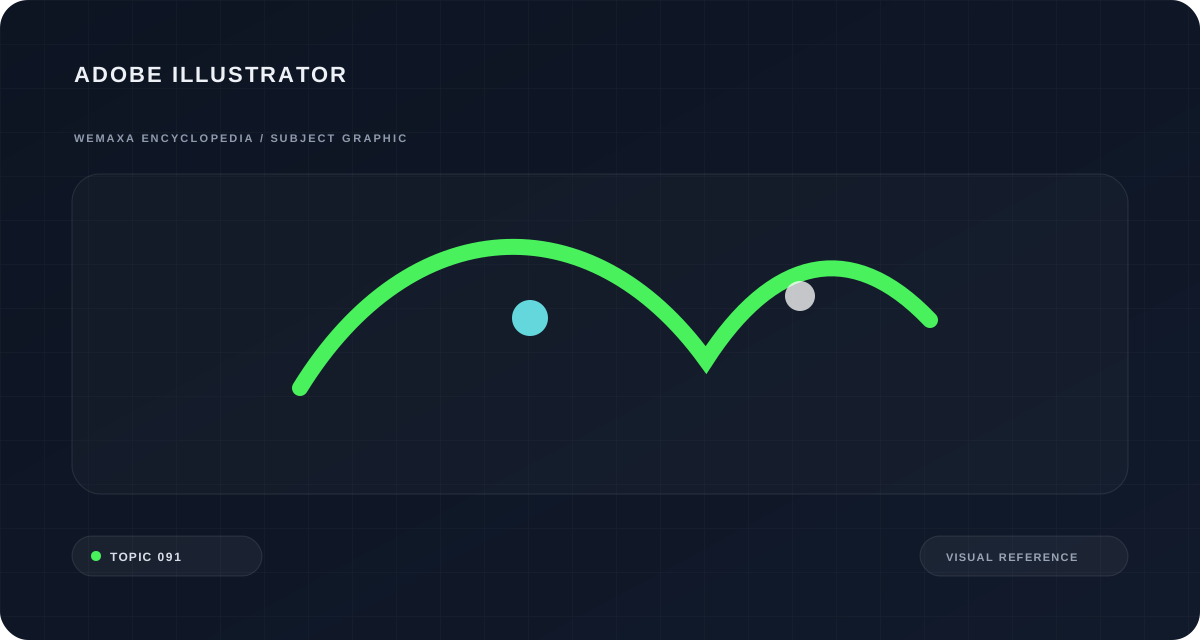
Adobe Illustrator
Adobe Illustrator is a vector drawing and typography application in which paths, anchor points, fills, strokes and reusable appearance attributes remain editable independently of output resolution.
Adobe Photoshop
Adobe Photoshop is fundamentally a pixel-based image editor built around layers, selections, masks and color adjustment. Its newer generative tools extend that workflow, but they sit on top of the same document structure rather than replacing it.
Blender
Blender is an open-source 3D content-creation application covering modeling, animation, simulation, rendering and compositing in one package. Its node systems make it especially important for procedural materials and geometry as well as conventional mesh work.
Figma
Figma is a collaborative interface-design environment built around vector objects, components, constraints, auto layout and shared design-system data. Its value is less about drawing isolated screens than about maintaining relationships among reusable interface states.

Generative AI in Design
Generative AI can create or transform images, text, vectors and interface prototypes, but professional design use depends on constraints, review, source handling and integration with ordinary design systems rather than on prompt output alone.
Web Design, UI/UX, CSS & Modern Browser Technology
Front-end systems and interface ideas that shape modern screen-based design.

CSS Container Queries
Container queries let component styles depend on a containing context rather than only on the viewport. Size queries solve the classic reusable-component problem, while newer query types extend the model to style, scrolling and anchor-positioning state.
CSS Flexbox
Flexbox is a one-dimensional layout model: it lays items primarily along one main axis, with a cross axis used for alignment. It is especially effective for navigation, toolbars, control groups, cards and components whose contents need to grow, shrink or distribute free space.
CSS Grid
CSS Grid is a two-dimensional layout system for coordinating rows and columns. It can define major page regions, editorial compositions and reusable components without the table hacks or float-based placement used by earlier web layouts.
CSS View Transitions
The View Transition API lets the browser capture old and new visual states and animate between them. It supports same-document interface changes and cross-document navigation, reducing the amount of custom snapshot and animation plumbing required for polished transitions.
Responsive Web Design
Responsive web design is an approach to making one web experience adapt to changing viewport, content and device conditions. It combines flexible layout with breakpoints, media handling and content priorities rather than maintaining a single fixed desktop canvas.