Wemaxa production AI infrastructure
Move AI from promising demo to reliable operational system.
We design and integrate data pipelines, compute, model deployment, MLOps, monitoring and secure AI services that perform predictably under real business workloads. The model is only one part of the system: data quality, context, access controls, orchestration, evaluation and observability are designed around it so AI features can move from prototype behavior to dependable production use.
The foundation beneath useful AI
Every layer prepared for repeatable intelligence.
AI value depends on much more than a model. Wemaxa connects clean data, appropriate compute, controlled deployment and continuous evaluation so intelligent features remain secure, observable and cost-aware as usage grows. We define how information enters the system, how models are versioned and served, how outputs are measured, and where human or policy controls belong—giving the product a foundation that can improve without becoming opaque or operationally fragile.
Data foundation
Batch and streaming pipelines, storage, transformation, lineage and quality controls for model-ready information.
Compute & training
Elastic CPU, GPU and TPU environments for experimentation, tuning and reproducible model development.
Serving & integration
Low-latency endpoints, autoscaling and dependable connections to products and business workflows.
Operations & trust
Monitoring, drift detection, access control, auditability, cost visibility and responsible AI safeguards.
Production AI lifecycle
Train once.
Operate continuously.
MLOps treats models as living production assets. Versioning, automated evaluation and controlled releases make improvements repeatable while keeping failures visible. Data preparation, experiments, deployment, monitoring and retraining are connected into one operating loop so model changes can be compared, approved, rolled out and reversed with the same discipline expected from other production software.
Infrastructure capabilities
Built around performance, control and measurable value.
Cloud, hybrid and edge architectures are selected according to latency, privacy, workload and cost—not because one environment fits every AI use case. We consider where data is allowed to live, how quickly inference must respond, which workloads need elastic compute, what must remain private, and how the system will be monitored. That keeps infrastructure decisions tied to operational reality instead of vendor preference.
Cloud & hybrid AI
Elastic services across AWS, Google Cloud, Azure, private environments and controlled hybrid deployments.
Data engineering
Airflow, Spark, ETL, streaming, model-ready datasets and reliable connections to enterprise sources.
Containers & orchestration
Portable Docker workloads, Kubernetes scaling, health management and reproducible environments.
Model serving
Secure inference APIs, load management, edge execution and integration with real products and processes.
Observability
Prometheus, Grafana, resource metrics, model quality, latency, data drift and actionable alerts.
Security & governance
Encryption, access controls, GDPR/HIPAA planning, explainability and responsible AI operating rules.
From input preparation to production operation
Six practical layers that turn AI into a working business system.
Useful AI is more than a model endpoint. It needs prepared inputs, product logic, system access, reliable context and measurable operating rules. These six layers show how Wemaxa moves from tokenization and implementation through integration, retrieval, agents and continuous optimization. Each layer solves a different production problem: preparing context correctly, connecting models to real systems, retrieving trustworthy information, coordinating tools or agents, and continuously checking whether the resulting behavior is still useful, safe and cost-effective.
Tokenization & context preparation
Raw text, documents and structured content are cleaned, chunked and converted into model-ready tokens with context windows, metadata and retrieval boundaries designed around the target model.
AI implementation
We turn a validated AI use case into an operational product layer: prompts, model calls, business logic, fallbacks, permissions, error states and measurable success criteria.
AI integration
Models are connected to websites, apps, CRMs, ecommerce systems, internal databases and APIs so intelligence can read context, trigger actions and return useful results inside existing workflows.
RAG & private knowledge systems
Company documents, product data and internal knowledge are indexed for controlled retrieval so AI responses can use current private context instead of relying only on the base model.
AI agents & workflow automation
Agent systems coordinate reasoning, tools and business actions across defined workflows—such as research, qualification, support, content operations or repetitive internal tasks.
Evaluation, cost & quality optimization
Production AI is measured against accuracy, latency, token usage, cost, safety and task completion so models and prompts can be improved with evidence rather than intuition.
Intelligence connected to action
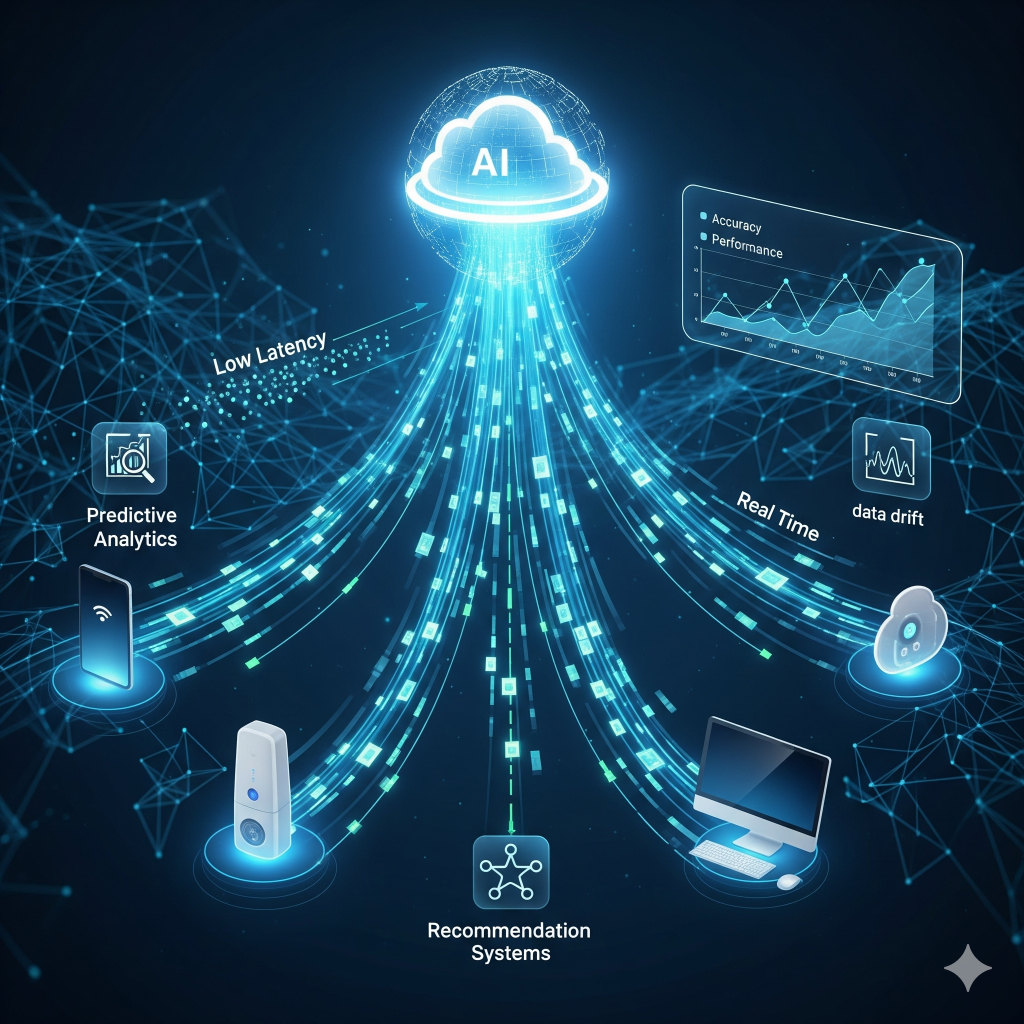
Models become valuable when they change what the business can do.
We connect AI services to ecommerce, CRM, ERP, analytics, support and operational tools—turning predictions and generation into controlled actions with measurable outcomes. Integrations are designed with permissions, fallbacks, logging and review points so AI can assist real workflows without becoming an untraceable layer between the customer, the model and the systems that actually run the business.
Ready to make AI operational?
Tell us about the data, models and workflows involved. We’ll help define a reliable infrastructure path—from ingestion and model serving through integrations, evaluation, monitoring and the controls needed to keep AI useful as the product and workload evolve.